*If convenient, time your visit to coincide with the Sikkim annual harvest festival called “Losung” in early December during which you can witness the fascinating, mysterious and colourful “Chham”, meaning dance, performed by lamas in most Buddhist monasteries of Sikkim held to free the world of evil spirits.
* Visit Rumtek, one of Sikkim’s most sacred monasteries and now home to the Karma Kagyu, or Black Hat- sect of Tibetan Buddhism. Founded during the 12th century, an unforgettable festival is held here every February.
* You may spot deer and the endangered red panda while hiking through deep and ancient forests on Maenam mountain in south-central Sikkim west of Gangtok while taking a day-long trek to the top.
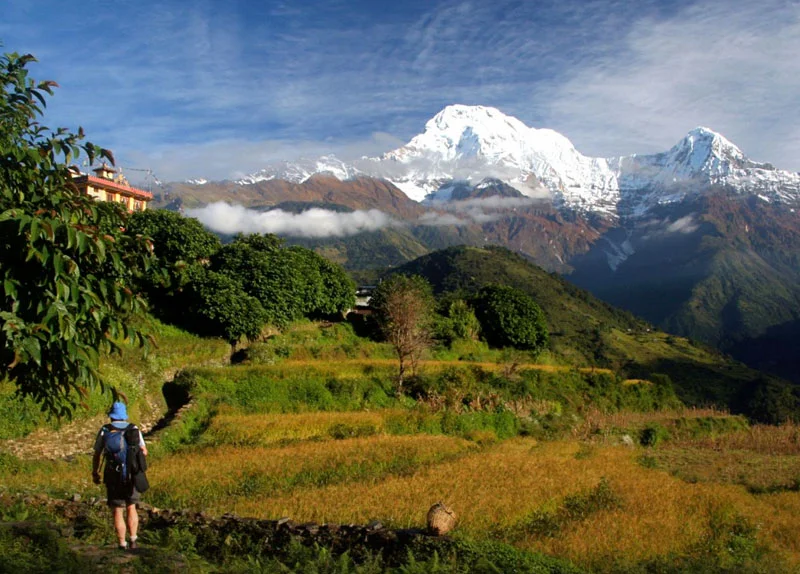
*From the beautiful 17th century monastery on a high ridge at Pemayangtse in the south-west you can see the neighbouring hills of Darjeeling District in the south and the Kanchenjunga massif straddling in the northon the Nepal-Sikkim border. The scholars here run courses in Buddhism, meditation and local crafts at the International Heritage Meditation Centre.
* Stupendous views and gentle trails through a botanist’s dream in the Varshey Rhododendron Sanctuary in Sikkim’s extreme south-western corner.
* Cross high alpine meadows through rhododendron forests on the east side of Kanchenjonga, world’s third highest mountain while trekking the Dzongri Trail.
* Hike past some the world’s most remote high-altitude lakes on the Singalila Ridge high-alpine trail and get some of the most stunning views of the eastern Himalayas extending from Kanchenjonga to Everest.
A Bit of Background
Known locally as “Denzong” (Tibetan word for “the Land of Rice”), the more widely known and used name “Sikkim” is derived from the Nepali-Limbu “Sukh-im” which means “happy homeland”. For centuries a self-isolated, independent Buddhist kingdom, it was, for strategic reasons, annexed in 1975 by a nexus of political and military forces to become a very small state of India, bordered on the east by Bhutan and China, in the north by China and in the west by Nepal.
Just 7,475 sq. kms. in area with altitude variations of 300 meters (msl) to 8,586 m, the height of Mt. Kanchenjonga, third highest peak in the world on western Nepal-India border, this tiny but refreshingly beautiful state offers a great deal for the world traveller, the adventurous trekker, students of Buddhist history and lovers of wild life and alpine flora.
Sikkim’s population is composed of 75% Hindu immigrants from Nepal (mostly Gurungs, Rais and Limbus), 20 % Lepchas (the original rulers) and Bhutias of Tibetan origin. There is also a huge number of plains Indians living and working here, mainly as businessmen, labourers and street vendors.
Despite recent changes, historically, culturally and spiritually, Sikkim identifies itself strongly with Tibet in the north. This is exemplified by the existence of more than 200 Buddhist monasteries, mostly belonging to the Nyingmapa sect. Pemayangtse in west Sikkim, Tashiding (built circa 1717) and Rumtek monasteries with large numbers of followers are witnesses to this fact. Rumtek, seat of the Gyalwa Karmappa, is perhaps the most influential monastery in Sikkim and it claims to have followers and converts in many western countries.
Sikkim is a botanist’s dream with some 4000 species of flowering plants and shrubs. Rare orchids, giant magnolia trees, varieties of rhododendron, gentian and potentilla are gloriously abundant in Sikkim’s well-protected forests. North Sikkim is famous for it’s cardamom output, a major export product, while the south, east and west have many apple orchards, orange groves and fields of paddy.
For wildlife enthusiasts, there are wild ass, blue sheep, black bear, flying squirrels, rhesus and langur monkeys, the endangered red Panda and the ever-elusive snow leopard.
The state capital, Gangtok, sprawls untidily on a ridge (1870 m) in the south-eastern part. Most of the constructions, big and small, old and new, face the north-west towards Kanchenjonga, Sikkim’s guardian deity, as it is thought to be auspicious. Notable places of interest are the Namgyal Institute of Tibetology, Enchey Monastery, the former Royal Chapel Tshuklakhang, the Institute of Cottage Industries, the Himalayan Zoological Park, the Flower Show Complex at the White Hall and the impressive Rumtek Monastery, 30 km to the west, a visit to which is a “must”. Also quite nearby are Tashi View Point (6 km), Kyongnosla Alpine Sanctuary (3350m) and Chhangu Lake, ((3750m) 35 km from Gangtok and 20 km from the Tibetan-Chinese border.
In West Sikkim, visits to the ancient monasteries at Pemayangtse and Tashiding and the old capital at Yoksum are highly popular. Most settled areas in Sikkim have their own complements of monasteries and shrines which maintain a strong historical and religious link with the past.
Trekking in Sikkim
Sir Francis Younghusband’s British troops trekked through east Sikkim in 1905 to invade Tibet and made it to Lhasa. But “trekking”, in the modern context, is relatively new here, largely due to international politics and sensitive border security issues. There is practically no trekking on the eastern side which borders the Kingdom of Bhutan and Chinese Tibet and next to impossible in the north. For the same reasons.
However, on the western flank bordering Nepal, there are many areas which provide great opportunities for trekking with a number of high peaks as destinations: Fluted Peak (6084m), Nepal Peak (6910m), Kanchenjonga (at 8586m the world’s third highest peak), Kabru (7338m), Kokhang (6147m), Kangla, with Lam Pokhari Lake (5200m) and Danpheybhir Tar (4400m). Talung Glacier, Zemm Glacier and Green Lake (4850m) in north-eastern Sikkim come as delightful sections of the trekking package.
The most popular high-altitude treks in Sikkim are the Dzongri-Goeche La routes and the Singalila Ridge. Treks from Lachen (central-north Sikkim) to Green Lake are possible but early permit arrangements must be made. Softer, low-level treks such as the rhododendron trails around Varshey in the south-western corner are pleasant alternatives and require only local permits for protected forests. There are many other options and rewarding possibilities throughout Sikkim which can be arranged.
While trekking permits in the higher areas also come under the purview of the security umbrella, Mountain Legend’s local agents in Sikkim are quite experienced in making the necessary arrangements for permits, hotel bookings and transport, experienced guides and camp teams.